Today’s labor market for nurses and other clinical providers is undergoing extreme strain. Health systems are facing unprecedented volatility in clinical rates, increased nurse turnover due to COVID-19, fallout from workers refusing vaccine mandates, and more. To answer these issues, health systems are innovating and adapting in all kinds of smart ways, including matching their rates to what nurses are demanding (and are worth) in a rapidly changing marketplace. In this article, we’ll look at what steps hospitals are taking to respond to current market conditions and explore how they can stay competitive and fill their resource needs.

Across the country, nurses are retiring, quitting temporarily to escape or recover from burnout, or taking higher paying gigs as travel or contract nurses. According to the 2021 NSI National Health Care Retention & RN Staffing Report, the nurse turnover rate stands at 18.7%.
Some nurses are also leaving due to new vaccine mandates. For example, New York-based Mohawk Valley Health System reported that it lost about 5% of its workforce due to New York’s vaccine mandate, pushing its already-high vacancy rate from 13.7% to 17.5%.
While fallout from vaccine mandates shouldn’t be overstated, even marginal or incremental losses of critical staff can be impactful when faced with a staffing crunch. “As a practical matter, [a vaccination mandate] policy may result in exacerbating the severe workforce shortage problems that currently exist,” American Hospital Association President and CEO Rick Pollack said in a Sept. 9 statement.

Due to these issues, health systems are paying more than ever for their clinical staff. Nurses leaving to become travelers has forced many systems to hire more travelers. As Marketplace puts it, “The job market for nurses is way out of whack. Traveling registered nurses are making far more than full-time staffers doing the same job. And that’s causing staffers to hit the road to take a traveling gig, only to be replaced by an expensive traveler.”
All told, the average weekly wages for a travel nurse have more than doubled since December 2019 in many cases, according to Becker’s Hospital Review.
This situation isn’t sustainable. “The hospital is not going to be able to survive on hiring travel nurses in perpetuity,” said Maureen Padilla, DNP, RN, senior vice president for nursing services at Houston-based Harris Health System, which increased pay for its emergency and ICU nurses to $140 an hour.

Some health systems are reducing capacity in order to cope. Time Magazine reports that New York-based Oneida Health reduced inpatient capacity by 25%, which enabled their surgeons to be able to treat patients from the ER.
Others are tapping other resources like educators, students, staff who normally do nonclinical work, and clinical staff who normally focus their efforts elsewhere. According to the Association of American Medical Colleges (AAMC), at Parkland Health & Hospital System in Dallas, Texas, doctors have been handling duties normally assigned to nurses and medical assistants.
Many health systems are looking to optimize their internal resource pools, with supporting technology like Einstein II (EII) that enables hospitals to effectively engage the contingent workforce and deploy resources across locations by placing the right resource in the right place at the right time. Read Einstein II case studies to find out first-hand how EII has helped other health systems solve their labor challenges.
But perhaps the most common response: hospitals are just paying way more.
April Kapu, DNP, RN, president of the American Association of Nurse Practitioners, says, “This pandemic has highlighted how important nurses are to the workforce, so bringing their pay in alignment with the market is more important than ever, because nurses are going to expect that.”
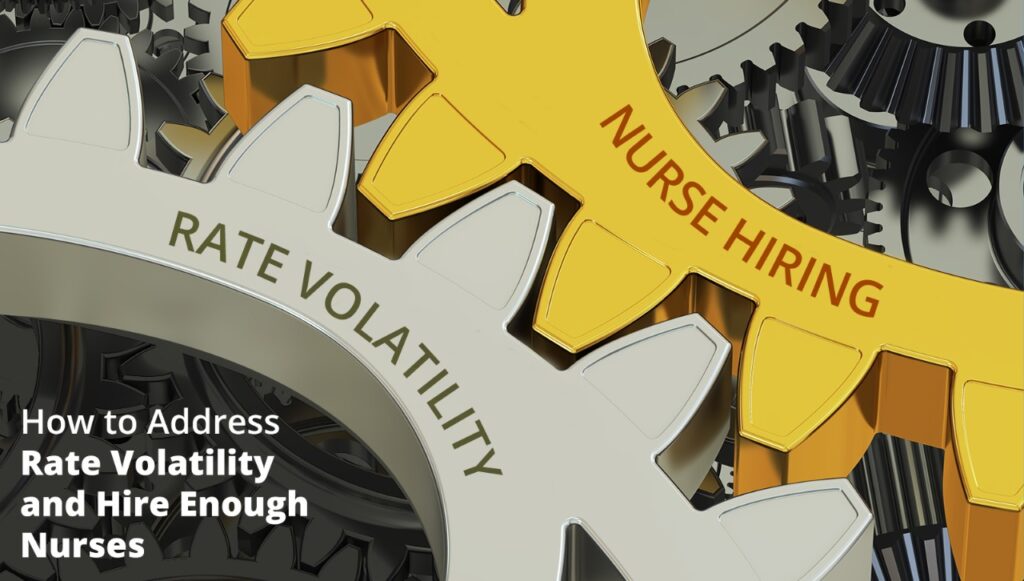
One challenge in this situation, however: not knowing what rates to set, accept, or allow; especially as market conditions change. The incredible volatility – from a pre-pandemic norm to pandemic highs that have been constantly rolling over the past year – has left a lot of uncertainty around how to price for nurses. It has also left hospitals risking paying too little (and being unable to fill open needs) or paying more than necessary.
Health systems need reliable clinical and nursing rate data for the state(s) they serve, aggregated from, and averaged across, hundreds of staffing agencies. To answer this need, Einstein II has compiled this data, and is providing it to any and all healthcare organizations at no cost, so that they are armed with competitive information when setting their rates. Request your rate report today.

Taken all together: “It’s a dire situation,” LouAnn Woodward, MD, vice chancellor at the University of Mississippi Medical Center (UMMC), told the AAMC. Health systems can’t afford to do nothing, and the best response is likely a combination of tactics like those described in this article. Regardless, the health systems best able to solve these challenges are those that are equipped with good information, good tools, and good strategy.
For help or more information about procuring such information, tools, or strategy, visit www.einsteinii.com.